Varys
A Clash of KingsVarys, known as the Spider, is a eunuch serving at the center of royal politics, but his real power lies outside formal office. He gathers secrets, measures the strength of competing claims, and turns conversation into a political instrument. His delicately mannered appearance conceals a survivor’s discipline and a strategist’s understanding that kings, priests, laws, gold, swords, and public belief become effective only when other people accept their authority.
Position and Introduction
Varys enters the political world of the royal court as an intermediary whose manners are almost theatrical. When Tyrion Lannister delivers a letter from Tywin Lannister, Varys examines the parchment and its gold sealing wax before acknowledging that it gives every appearance of being genuine. The gesture is more than bureaucratic caution: Varys turns a simple message into a test of authenticity, perception, and trust. His attention to the seal establishes him as a man who reads objects and performances as carefully as words.
He welcomes Tyrion Lannister’s arrival while simultaneously warning him. Varys says that the council has dire need of him and asks whether he has seen the red comet, which he identifies as the Red Messenger. In the streets, he reports, people interpret it as a herald before a king and a warning of fire and blood. Varys therefore functions as both observer and interpreter: he does not merely know what the city says, but understands how popular language converts an astronomical sign into political expectation.
Riddles and the Nature of Power
Varys’s characteristic method is the riddle, a form that lets him reveal dangerous truths while preserving room to retreat. He presents Tyrion Lannister with a scene involving a king, a priest, a rich man, and a common-born sellsword. Each powerful figure commands the sellsword to kill the others, invoking lawful rule, divine authority, or gold. The apparent puzzle asks which great man will survive, but Varys’s real subject is the invisible source of obedience. Tyrion’s answer remains uncertain because the outcome depends on the sellsword, the supposedly insignificant figure who actually holds the decisive choice.
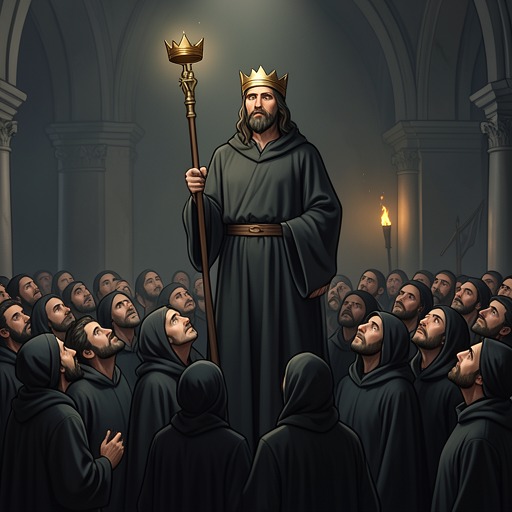
Varys later makes the principle explicit: “Power resides where men believe it resides. No more and no less.” He describes power as a mummer’s trick and a shadow on the wall, while adding that shadows can kill and that a very small man can cast a very large shadow. The formulation explains Varys himself. He possesses no army, hereditary claim, or openly displayed martial stature, yet his knowledge and ability to shape decisions allow him to influence people who publicly possess all three. His smallness is not simply a physical description; it becomes an image of concealed political reach.
That theory also governs his interpretation of Eddard Stark’s execution. Varys asks whether responsibility belonged to Joffrey Baratheon, who gave the command, Ser Ilyn Payne, who swung the sword, or someone else. By separating command, execution, and hidden causation, he challenges the assumption that visible office identifies actual power. The question makes political authority a chain of belief and compliance rather than a single possession.
Networks, Threats, and Political Surveillance
Varys’s civility is inseparable from surveillance. When Tyrion Lannister’s young woman is mentioned, Varys praises her amiable manner but warns that Tyrion should take very good care of her. Tyrion answers with a threat: any man who harms her will lose his head. Varys does not openly challenge him, yet the exchange establishes that both men understand intimacy as a vulnerability that can be observed, exploited, and defended. Their conversation is not private in the ordinary sense; it is a negotiation between two intelligence systems.
Varys presents himself as a servant of the court, but his speech repeatedly destabilizes the court’s official explanations. He can discuss what people say in the streets, question the meaning of celestial omens, and connect apparently separate incidents to the larger contest between rulers. His manner encourages others to underestimate the seriousness of what he is saying. Laughter, courtesy, and elaborate phrasing soften the surface while leaving the warning intact.
His conduct also contrasts with the public rituals of kingship. Stannis Baratheon proclaims his claim through birth, blood, and a formal declaration against the legitimacy of Joffrey Baratheon, Tommen, and Myrcella, while Renly Baratheon argues that Robert Baratheon won the Iron Throne with his warhammer and that force made his claim effective. Varys’s doctrine accommodates both arguments while exposing their dependence on collective acceptance. A legal declaration and a victorious army are different instruments, but each requires men to recognize and obey the authority it represents.
Testimony and the Making of the Spider
When Varys finally explains how he became a eunuch, the cultivated courtier gives way to a history of extreme vulnerability and deliberate survival. He was an orphan boy apprenticed to a traveling folly whose master owned a small ship and performed throughout the Free Cities, Oldtown, and King’s Landing. At Myr, a man purchased him from the master and drugged him into helplessness while remaining fully conscious. The man removed his manhood with a long hooked blade, burned it on a brazier, and performed a chant; the flames turned blue, and Varys heard a voice answer the summons.
Afterward, the performers sailed away, and the man who had used him abandoned him with the expectation that he would die. Varys chose to live in defiance of that expectation. He begged, stole, and sold what parts of his body remained to him, becoming an accomplished thief in Myr. As he grew older, he discovered that the contents of letters could be more valuable than the contents of a purse. This realization supplies the foundation of his later power: physical survival becomes informational survival, and theft develops into the collection of secrets.
The story does not erase the mystery surrounding Varys; it deepens it. His account links bodily mutilation, occult terror, abandonment, poverty, literacy, and espionage without reducing him to any one of them. The boy who was treated as disposable becomes the adult who understands that secrets are portable wealth and that people who appear powerful may be governed by what they fear others will learn.
Varys and the Political Meaning of Fear
Varys’s observations gain force during the riot in King’s Landing, when public anger overwhelms the symbols of royal authority. The crowd hurls abuse at Joffrey Baratheon, Cersei Lannister, and Tyrion Lannister, calls for justice, names Robb Stark, Stannis Baratheon, and Renly Baratheon, and then abandons those rival kings in favor of a simpler demand: bread. The crowd surges against the City Watch, throws stones, dung, and other missiles, and briefly turns the streets into a place where banners and titles cannot guarantee safety.
Although Varys is not shown directing the riot, the scene demonstrates the political condition his riddles describe. Formal legitimacy collapses when hunger, hatred, and fear persuade ordinary people that the visible rulers no longer deserve obedience. Joffrey Baratheon’s crown, the banners of House Baratheon and House Lannister, and the armed defense of the City Watch become fragile performances. The event gives concrete meaning to Varys’s claim that power resides where men believe it resides: in the street, belief shifts rapidly, and authority follows.
Varys’s position is likewise illuminated by the later restoration of ceremony. Tywin Lannister arrives in burnished red armor, accepts governance of the realm until Joffrey Baratheon comes of age, and receives the Hand’s chain of office. Joffrey then stages a public celebration in which the Tyrells are honored as supporters of the realm. The ceremony attempts to make political order visible again through armor, heralds, chains, gold, roses, and proclaimed alliances. Varys’s importance lies in seeing the mechanism beneath such pageantry: the symbols matter because people are made to recognize them, repeat them, and act according to them.